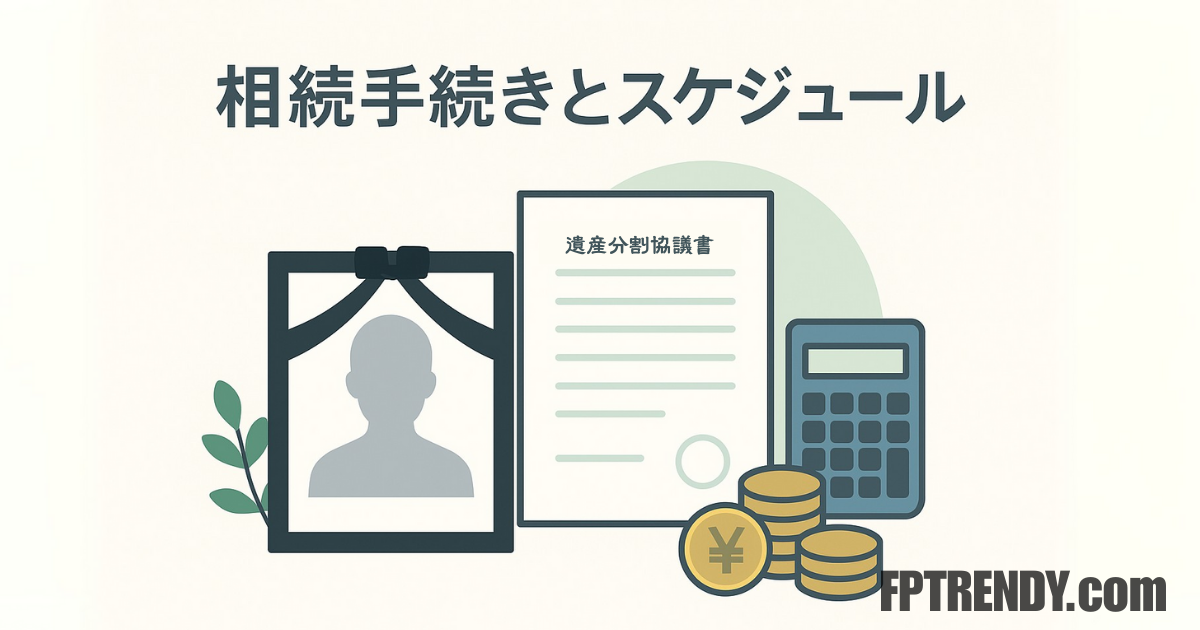
After a person dies, there are many procedures waiting for the bereaved family. In the midst of the enormous emotional burden of wakes and funerals, there are many things that are a race against time, such as administrative procedures and filing and paying inheritance tax.
Here Flow from death to inheritance tax declaration and payment I will explain it in chronological order in an easy-to-understand manner.
There are detailed regulations that are not described in each procedure and system, but in this article, please grasp the flow with a general explanation.
🕊️ Chapter 1: Procedures to be performed immediately after death (within 1 week)
Preparation and execution of wakes and funerals
As a ritual to send off a loved one, Wake & Funeral is the first event that comes to mind for many people.
- Decision of the mourners
- Selection and meeting of funeral directors
- Arrangement of venues, requests to monks and priests, etc.
- Contacting relatives and attendees
- Wake → Funeral and farewell ceremony → Cremation is common
Submission of death certificate (within 7 days)
Including the date of death Within 7 days It must be submitted to:
- Notifiers: Relatives, cohabitants, guardians, etc.
- Submission to: The municipality of the place of death, permanent domicile, or location of the notifier
- Death certificate or autopsy report required
Obtaining a Cremation Permit
Apply at the same time as the death certificate. Without this, cremation is not possible.
Various certification and return procedures
- Return of health insurance card, driver's license, etc.
- Notification of change of head of household (to the government office where the certificate of residence is located)
- In the case of pensioners, it is also necessary to return the death notification (Article 104 of the National Pension Act, etc.) to the pension office and the My Number Card.
📜 Chapter 2: Preparation to be made by 49 days after death (within 1-2 months)
Check if there is a will
- Notarized will: Confirmed at a notary public office
- Autograph will: Probate required in family court
- However, probate is not required under the Legal Affairs Bureau's storage system (autograph will storage system) that started in July 2020.
* There are various forms and systems for wills, so I will write a separate article.
Investigation of heirs
- Collection of family registers (from birth to death)
- Necessary to establish legal heirs
Inventory of property
- Deposits, real estate, stocks, life insurance, debts, etc.
- Confirm both "positive assets" and "negative assets"
- Confirmation of digital assets (e.g., crypto assets, SNS accounts) and overseas assets, etc.
Consideration of inheritance renunciation and limited approval (within 3 months)
- Means to avoid incurring debts for heirs
- A petition to the Family Court is required.
- Cases in which it is possible to apply for an extension of the deliberation period (Article 915, Paragraph 2 of the Civil Code), and cases in which reinheritance is not possible after renunciation of inheritance, etc.
Preparation for the memorial service
- Preparation and execution of the 49-day memorial service
- Preparations for the return of incense are also common at this time of year
- There are regional differences in religion (e.g., Shinto 50-day festival) and incense returns.
🧾 Chapter 3: What to Decide Within 3 Months
Decision-making for approval or renunciation of inheritance
- Whether or not you receive an inheritance depends on As a general rule, within 3 months from the date of learning of death Judgment on
Procedures for Renunciation of Inheritance and Limited Approval
- Renunciation of inheritance: Waiver of all rights and obligations
- Limited Authorization: Succession of debts within the scope of positive property
🧮 Chapter 4: Quasi-final tax return to be filed within 4 months
Declaring the decedent's income tax return (quasi-final tax return)
- Declare income from January 1 of the year of death to the date of death
- Filed by heirs in joint names
- What are the deadlines for filing and paying taxes? Within 4 months from the date of death
💰 Chapter 5: Filing and paying inheritance tax within 10 months
Valuation of inherited property and consultation on division of inheritance
- Valuation of real estate, stocks, business assets, etc.
- All the heirs discuss "who will inherit what"
Preparation of an estate division agreement
- Each person's signature, registered seal, and seal impression certificate are required.
- Indispensable when changing the name or filing a tax return
Filing and paying inheritance tax (within 10 months)
- To the tax office within 10 months from the date of the decedent's death
- principle Lump sum cash payment 。 Deferred payment and in-kind payment are also conditionally possible.
🏁 Chapter 6: Completion of Name Change and Inheritance Procedures
Various name changes
- Real Estate Registration (Legal Affairs Bureau)
- Refund of Deposits and Name Change
- Change of name of shares and automobiles
- Claims for life insurance benefits, death retirement benefits, etc.
Distribution of inheritance and future precautions for heirs
- Tax management is necessary according to the acquired assets of each person.
- Be sure to check insurance benefits and gifts that are not included in your inheritance.
🧑 💼 Utilization of experts and promotion of schedule management
The inheritance procedure has a fixed deadline, especially 3 months, 4 months, 10 months Timing is key. To ensure a smooth process, you can benefit from the following professional support:
- Tax accountant: Inheritance tax assessment and declaration
- Lawyers: Estate division and dispute measures
- Judicial scrivener: registration procedure
Checklists and schedules to manage the progress of the procedure.